单选题 (共 35 题 ),每题只有一个选项正确
设 $M=\int_{-\frac{\pi}{2}}^{\frac{\pi}{2}} \frac{\sin x}{1+x^{2}} \cos ^{4} x \mathrm{~d} x, N=\int_{-\frac{\pi}{2}}^{\frac{\pi}{2}}\left(\sin ^{3} x+\cos ^{4} x\right) \mathrm{d} x, P=\int_{-\frac{\pi}{2}}^{\frac{\pi}{2}}\left(x^{2} \sin ^{3} x-\cos ^{4} x\right) \mathrm{d} x$, 则有
$\text{A.}$ $N < P < M$.
$\text{B.}$ $M < P < N$.
$\text{C.}$ $N < M < P$.
$\text{D.}$ $P < M < N$.
设在 $[0,1]$ 上 $f^{\prime \prime}(x)>0$, 则 $f^{\prime}(0), f^{\prime}(1), f(1)-f(0)$ 或 $f(0)-f(1)$ 的大小顺序是
$\text{A.}$ $f^{\prime}(1)>f^{\prime}(0)>f(1)-f(0)$.
$\text{B.}$ $f^{\prime}(1)>f(1)-f(0)>f^{\prime}(0)$.
$\text{C.}$ $f(1)-f(0)>f^{\prime}(1)>f^{\prime}(0)$.
$\text{D.}$ $f^{\prime}(1)>f(0)-f(1)>f^{\prime}(0)$.
下列广义积分收敛的是
$\text{A.}$ $\int_e^{+\infty} \frac{\ln x}{x} \mathrm{~d} x$
$\text{B.}$ $\int_e^{+\infty} \frac{\mathrm{d} x}{x \ln x}$
$\text{C.}$ $\int_e^{+\infty} \frac{\mathrm{d} x}{x(\ln x)^2}$
$\text{D.}$ $\int_e^{+\infty} \frac{\mathrm{d} x}{x \sqrt{\ln x}}$
在下列等式中,正确的结果是
$\text{A.}$ $\int f^{\prime}(x) \mathrm{d} x=f(x)$
$\text{B.}$ $\int \mathrm{d} f(x)=f(x)$
$\text{C.}$ $\frac{\mathrm{d}}{\mathrm{d} x} \int f(x) \mathrm{d} x=f(x)$
$\text{D.}$ $\mathrm{d} \int f(x) \mathrm{d} x=f(x)$
设函数 $f(x)$ 在 $(-\infty,+\infty)$ 上连续,则 $\mathrm{d}\left[\int f(x) \mathrm{d} x\right]$ 等于
$\text{A.}$ $f(x)$
$\text{B.}$ $f(x) \mathrm{d} x$
$\text{C.}$ $f(x)+C$
$\text{D.}$ $f^{\prime}(x) \mathrm{d} x$
设函数 $f(x)=\left\{\begin{array}{cc}x^2 & 0 \leq x \leq 1 \\ 2-x & 1 < x \leq 2\end{array}\right.$ ,记$F(x)=\int_0^x f(t) \mathrm{d} t, 0 \leq x \leq 2$, 则
$\text{A.}$ $F(x)=\left\{\begin{array}{cl}\frac{x^3}{3}, & 0 \leq x \leq 1 \\ \frac{1}{3}+2 x-\frac{x^2}{2}, & 1 < x \leq 2\end{array}\right.$
$\text{B.}$ $F(x)=\left\{\begin{array}{cc}\frac{x^3}{3}, & 0 \leq x \leq 1 \\ -\frac{7}{6}+2 x-\frac{x^2}{2}, 1 < x \leq 2\end{array}\right.$
$\text{C.}$ $F(x)=\left\{\begin{array}{cr}\frac{x^3}{3}, & 0 \leq x \leq 1 \\ \frac{x^3}{3}+2 x-\frac{x^2}{2}, 1 < x \leq 2\end{array}\right.$
$\text{D.}$ $F(x)=\left\{\begin{array}{c}\frac{x^3}{3}, \quad 0 \leq x \leq 1 \\ 2 x-\frac{x^2}{2}, 1 < x \leq 2\end{array}\right.$
设 $f(x)$ 连续, $F(x)=\int_0^{x^2} f\left(t^2\right) \mathrm{d} t$ ,则 $F^{\prime}(x)$ 等于
$\text{A.}$ $f\left(x^4\right)$
$\text{B.}$ $x^2 f\left(x^4\right)$
$\text{C.}$ $2 x f\left(x^4\right)$
$\text{D.}$ $2 x f\left(x^2\right)$
若 $f(x)$ 的导数是 $\sin x$ ,则 $f(x)$ 有一个原函数为
$\text{A.}$ $1+\sin x$
$\text{B.}$ $1-\sin x$
$\text{C.}$ $1+\cos x$
$\text{D.}$ $1-\cos x$
已知 $f(x)=\left\{\begin{array}{ll}x^2 & 0 \leq x < 1 \\ 1 & 1 \leq x \leq 2\end{array}\right.$ ,设
$$
F(x)=\int_1^x f(t) \mathrm{d} t(0 \leq x \leq 2) ,
$$
则 $f(x)$ 为
$\text{A.}$ $\left\{\begin{array}{l}\frac{1}{3} x^3, 0 \leq x < 1 \\ x, 1 \leq x \leq 2\end{array}\right.$
$\text{B.}$ $\left\{\begin{array}{l}\frac{1}{3} x^3-\frac{1}{3}, 0 \leq x < 1 \\ x, 1 \leq x \leq 2\end{array}\right.$
$\text{C.}$ $\left\{\begin{array}{l}\frac{1}{3} x^3, 0 \leq x < 1 \\ x-1,1 \leq x \leq 2\end{array}\right.$
$\text{D.}$ $\begin{cases}\frac{1}{3} x^3-\frac{1}{3} & 0 \leq x < 1 \\ x-1 & 1 \leq x \leq 2\end{cases}$
设 $f(x)$ 为连续函数,且 $F(x)=\int_{\frac{1}{x}}^{\ln x} f(t) \mathrm{d} t$ ,则 $F^{\prime}(x)$ 等于
$\text{A.}$ $\frac{1}{x} f(\ln x)+\frac{1}{x^2} f\left(\frac{1}{x}\right)$
$\text{B.}$ $f(\ln x)+f\left(\frac{1}{x}\right)$
$\text{C.}$ $\frac{1}{x} f(\ln x)-\frac{1}{x^2} f\left(\frac{1}{x}\right)$
$\text{D.}$ $f(\ln x)-f\left(\frac{1}{x}\right)$
设 $M=\int_{-\frac{\pi}{2}}^{\frac{\pi}{2}} \frac{\sin x}{1+x^2} \cos ^4 x \mathrm{~d} x$ ,
$$
\begin{aligned}
& N=\int_{-\frac{\pi}{2}}^{\frac{\pi}{2}}\left(\sin ^3 x+\cos ^4 x\right) \mathrm{d} x, \\
& P=\int_{-\frac{\pi}{2}}^{\frac{\pi}{2}}\left(x^2 \sin ^3 x-\cos ^4 x\right) \mathrm{d} x
\end{aligned}
$$
则
$\text{A.}$ $N < P < M$
$\text{B.}$ $M < P < N$
$\text{C.}$ $N < M < P$
$\text{D.}$ $P < M < N$
曲线 $y=x(x-1)(2-x)$ 与 $x$ 轴所围图形的面积可表示为
$\text{A.}$ $-\int_0^2 x(x-1)(2-x) \mathrm{d} x$
$\text{B.}$ $\int_0^1 x(x-1)(2-x) \mathrm{d} x-\int_1^2 x(x-1)(2-x) \mathrm{d} x$
$\text{C.}$ $-\int_0^1 x(x-1)(2-x) \mathrm{d} x+\int_1^2 x(x-1)(2-x) \mathrm{d} x$
$\text{D.}$ $\int_0^2 x(x-1)(2-x) \mathrm{d} x$
下列广义积分发散的是
$\text{A.}$ $\int_{-1}^1 \frac{1}{\sin x} \mathrm{~d} x$
$\text{B.}$ $\int_{-1}^1 \frac{1}{\sqrt{1-x^2}} \mathrm{~d} x$
$\text{C.}$ $\int_0^{+\infty} e^{-x^2} \mathrm{~d} x$
$\text{D.}$ $\int_2^{+\infty} \frac{1}{x \ln ^2 x} \mathrm{~d} x$
累次积分 $\int_0^{\frac{\pi}{2}} \mathrm{~d} \theta \int_0^{\cos \theta} f(r \cos \theta, r \sin \theta) r \mathrm{~d} r$
$\text{A.}$ $\int_0^1 \mathrm{~d} y \int_0^{\sqrt{y-y^2}} f(x, y) \mathrm{d} x$
$\text{B.}$ $\int_0^1 \mathrm{~d} y \int_0^{\sqrt{1-y^2}} f(x, y) \mathrm{d} x$
$\text{C.}$ $\int_0^1 \mathrm{~d} x \int_0^1 f(x, y) \mathrm{d} y$
$\text{D.}$ $\int_0^1 \mathrm{~d} x \int_0^{\sqrt{x-x^2}} f(x, y) \mathrm{d} y$
设 $F(x)=\int_x^{x+2 \pi} e^{\sin t} \sin t \mathrm{~d} t$ ,则 $F(x)$
$\text{A.}$ 为正常数
$\text{B.}$ 为负常数
$\text{C.}$ 恒为零
$\text{D.}$ 不为常数
设 $F(x)=\int_x^{x+2 \pi} e^{\sin t} \sin t \mathrm{~d} t$ ,则 $F(x)$
$\text{A.}$ 为正常数
$\text{B.}$ 为负常数
$\text{C.}$ 恒为零
$\text{D.}$ 不为常数
设 $f(x), \varphi(x)$ 在点 $x=0$ 的某邻域内连续,且当 $x \rightarrow 0$时, $f(x)$ 是 $\varphi(x)$ 的高阶无穷小,则当 $x \rightarrow 0$ 时, $\int_0^x f(t) \sin t \mathrm{~d} t$ 是 $\int_0^x t \varphi(t) \mathrm{d} t$ 的
$\text{A.}$ 低阶无穷小
$\text{B.}$ 高阶无穷小
$\text{C.}$ 同阶但不等价的无穷小
$\text{D.}$ 等价无穷小
设 $f(x)$ 连续,则 $\frac{\mathrm{d}}{\mathrm{d} x} \int_0^x t f\left(x^2-t^2\right) \mathrm{d} t=$
$\text{A.}$ $x f\left(x^2\right)$
$\text{B.}$ $-x f\left(x^2\right)$
$\text{C.}$ $2 x f\left(x^2\right)$
$\text{D.}$ $-x f\left(x^2\right)$
设 $f(x)$ 是连续函数, $F(x)$ 是 $f(x)$ 的原函数 则
$\text{A.}$ 当 $f(x)$ 是奇函数时, $F(x)$ 必是偶函数
$\text{B.}$ 当 $f(x)$ 是偶函数时, $F(x)$ 必是奇函数
$\text{C.}$ 当 $f(x)$ 是是周期函数时, $F(x)$ 必是周期函数
$\text{D.}$ 当 $f(x)$ 是单调增函数时, $F(x)$ 必是单调增函数
设 $f(x)$ 是连续函数, $F(x)$ 是 $f(x)$ 的原函数,则
$\text{A.}$ 当 $f(x)$ 是奇函数时, $F(x)$ 必是偶函数
$\text{B.}$ 当 $f(x)$ 是偶函数时, $F(x)$ 必是奇函数
$\text{C.}$ 当 $f(x)$ 是是周期函数时, $F(x)$ 必是周期函数
$\text{D.}$ 当 $f(x)$ 是单调增函数时, $F(x)$ 必是单调增函数
设 $I_1=\int_0^{\frac{\pi}{4}} \frac{\tan x}{x} \mathrm{~d} x, I_2=\int_0^{\frac{\pi}{4}} \frac{x}{\tan x} \mathrm{~d} x$ ,则
$\text{A.}$ $I_1>I_2>1$
$\text{B.}$ $1>I_1>I_2$
$\text{C.}$ $I_2>I_1>1$
$\text{D.}$ $1>I_2>I_1$
设 $f(x)$ 为连续函数, $F(t)=\int_1^t \mathrm{~d} y \int_y^t f(x) \mathrm{d} x$ ,则 $F^{\prime}(2)$ 等于
$\text{A.}$ $2 f(2)$
$\text{B.}$ $f(2)$
$\text{C.}$ $-f(2)$
$\text{D.}$ 0
把 $x \rightarrow 0^{+}$时的无穷小量
$$
\alpha=\int_0^x \cos t^2 \mathrm{~d} t, \beta=\int_0^{x^2} \tan \sqrt{t} \mathrm{~d} t, \gamma=\int_0^{\sqrt{x}} \sin t^3 \mathrm{~d} t ,
$$
排列起来,使排在后面的是前一个的高阶无穷小,则正确的排列次序是
$\text{A.}$ $\alpha, \beta, \gamma$
$\text{B.}$ $\alpha, \gamma, \beta$
$\text{C.}$ $\beta, \alpha, \gamma$
$\text{D.}$ $\beta, \gamma, \alpha$
设 $F(x)$ 是连续函数 $f(x)$ 的一个原函数," $M \Leftrightarrow N$ "表示" $M$ 的充分必要条件是 $N$ ",则必有
$\text{A.}$ $F(x)$ 是偶函数 $\Leftrightarrow f(x)$ 是奇函数
$\text{B.}$ $F(x)$ 是奇函数 $\Leftrightarrow f(x)$ 是偶函数
$\text{C.}$ $F(x)$ 是周期函数 $\Leftrightarrow f(x)$ 是周期函数
$\text{D.}$ $F(x)$ 是单调函数 $\Leftrightarrow f(x)$ 是单调函数
下列结论正确的是
$\text{A.}$ $\int_1^{+\infty} \frac{\mathrm{d} x}{x(x+1)}$ 与 $\int_0^1 \frac{\mathrm{d} x}{x(x+1)}$ 都收敛
$\text{B.}$ $\int_1^{+\infty} \frac{\mathrm{d} x}{x(x+1)}$ 与 $\int_0^1 \frac{\mathrm{d} x}{x(x+1)}$ 都发散
$\text{C.}$ $\int_1^{+\infty} \frac{\mathrm{d} x}{x(x+1)}$ 发散, $\int_0^1 \frac{\mathrm{d} x}{x(x+1)}$ 收敛
$\text{D.}$ $\int_1^{+\infty} \frac{\mathrm{d} x}{x(x+1)}$ 收敛, $\int_0^1 \frac{\mathrm{d} x}{x(x+1)}$ 发散
设 $I_1=\iint_D \cos \sqrt{x^2+y^2} \mathrm{~d} \sigma , I_2=\iint_D \cos \left(x^2+y^2\right) \mathrm{d} \sigma$ , $I_3=\iint_D \cos \left(x^2+y^2\right)^2 \mathrm{~d} \sigma$ ,其中 $D=\left\{(x, y) \mid x^2+y^2 \leq 1\right\}$ ,则
$\text{A.}$ $I_3>I_2>I_1$.
$\text{B.}$ $I_1>I_2>I_3$.
$\text{C.}$ $I_2>I_1>I_3$
$\text{D.}$ $I_3>I_1>I_2$.
设 $f(x)$ 是奇函数,除 $x=0$ 外处处连续, $x=0$ 是其第一类间断点,则 $\int_0^x f(t) \mathrm{d} t$ 是
$\text{A.}$ 连续的奇函数
$\text{B.}$ 连续的偶函数
$\text{C.}$ 在 $\boldsymbol{x}=\mathbf{0}$ 间断的奇函数
$\text{D.}$ 在 $\boldsymbol{x}=0$ 间断的偶函数
设 $f(x, y)$ 为连续函数,则 $\int_0^{\frac{\pi}{4}} \mathrm{~d} \theta \int_0^1 f(r \cos \theta, r \sin \theta) r \mathrm{~d} r$ 等于
$\text{A.}$ $\int_0^{\frac{\sqrt{2}}{2}} \mathrm{~d} x \int_x^{\sqrt{1-x^2}} f(x, y) \mathrm{d} y$
$\text{B.}$ $\int_0^{\frac{\sqrt{2}}{2}} \mathrm{~d} x \int_0^{\sqrt{1-x^2}} f(x, y) \mathrm{d} y$
$\text{C.}$ $\int_0^{\frac{\sqrt{2}}{2}} \mathrm{~d} y \int_y^{\sqrt{1-y^2}} f(x, y) \mathrm{d} x$
$\text{D.}$ $\int_0^{\frac{\sqrt{2}}{2}} \mathrm{~d} y \int_0^{\sqrt{1-y^2}} f(x, y) \mathrm{d} x$
设函数 $f(x)$ 与 $g(x)$ 在 $[0,1]$ 上连续,且 $f(x) \leq g(x)$ ,则对任何 $c \in(0,1)$ ,有
$\text{A.}$ $\int_{\frac{1}{2}}^c f(t) \mathrm{d} t \geq \int_{\frac{1}{2}}^c g(t) \mathrm{d} t$
$\text{B.}$ $\int_{\frac{1}{2}}^c f(t) \mathrm{d} t \leq \int_{\frac{1}{2}}^c g(t) \mathrm{d} t$
$\text{C.}$ $\int_c^1 f(t) \mathrm{d} t \geq \int_c^1 g(t) \mathrm{d} t$
$\text{D.}$ $\int_c^1 f(t) \mathrm{d} t \leq \int_c^1 g(t) \mathrm{d} t$
连续函数 $y=f(x)$ 在区间 $[-3,-2] ,[2,3]$ 上的图形分别是直径为 1 的上、下半圆周,在区间 $[-2,0] ,[0,2]$ 的图形分别是直径为 2 的下、上半圆周,设 $F(x)=\int_0^x f(t) \mathrm{d} t$ ,则下列结论正确的是
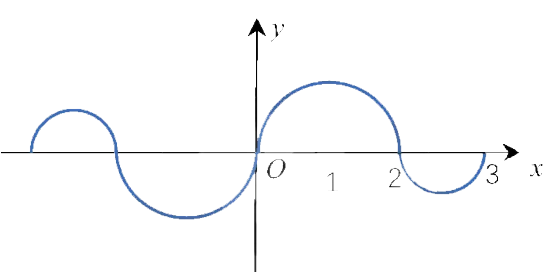
$\text{A.}$ $F(3)=-\frac{3}{4} F(-2)$
$\text{B.}$ $F(3)=\frac{5}{4} F(2)$
$\text{C.}$ $F(-3)=\frac{3}{4} F(2)$
$\text{D.}$ $F(-3)=-\frac{5}{4} F(-2)$
设曲线 $L: f(x, y)=1(f(x, y)$ 具有一阶连续偏导数),过第 2 象限内的点 $M$ 和第 4 象限内的点 $N, \Gamma$ 为 $L$ 上从点 $M$到点 $N$ 的一段弧,则下列积分小于零的是
$\text{A.}$ $\int_{\Gamma} f(x, y) \mathrm{d} x$
$\text{B.}$ $\int_{\Gamma} f(x, y) \mathrm{d} y$
$\text{C.}$ $\int_{\Gamma} f(x, y) \mathrm{d} s$
$\text{D.}$ $\int_{\Gamma} f_x^{\prime}(x, y) \mathrm{d} x+f_y^{\prime}(x, y) \mathrm{d} y$
如图,曲线方程为 $y=f(x)$ ,函数 $f(x)$ 在区间 $[0, a]$ 上有连续导数,则定积分 $\int_0^a x f^{\prime}(x) \mathrm{d} x$ 在几何上表示
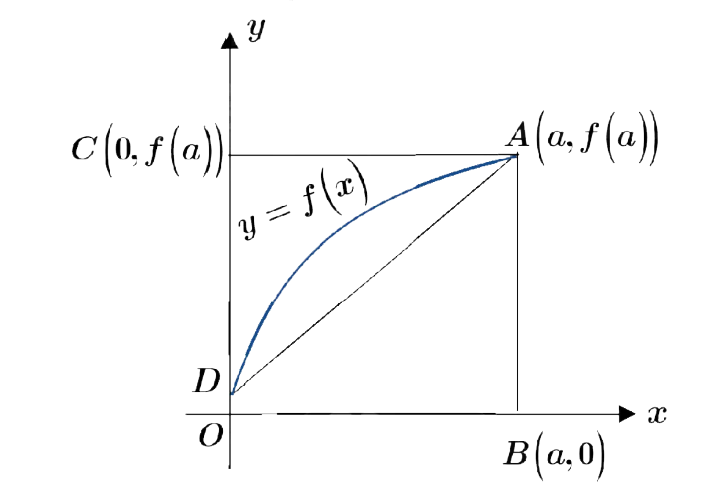
$\text{A.}$ 曲边梯形 $A B O D$ 的面积
$\text{B.}$ 梯形 $A B O D$ 的面积
$\text{C.}$ 曲边三角形 $A C D$ 面积
$\text{D.}$ 三角形 $A C D$ 面积
如图,曲线方程为 $y=f(x)$ ,函数 $f(x)$ 在区间 $[0, a]$ 上有连续导数,则定积分 $\int_0^a x f^{\prime}(x) \mathrm{d} x$ 在几何上表示
$\text{A.}$ 曲边梯形 $A B O D$ 的面积
$\text{B.}$ 梯形 $A B O D$ 的面积
$\text{C.}$ 曲边三角形 $A C D$ 面积
$\text{D.}$ 三角形 $A C D$ 面积
如图所示,正方形 $\{(x, y) \| x|\leq 1| y \mid, \leq 1\}$ 被其对角线划分为四个区域 $D_k(k=1,2,3,4) , I_k=\iint_{D_k} y \cos x \mathrm{~d} x \mathrm{~d} y$ ,则 $\max _{1 \leq k \leq 4}\left\{I_k\right\}=$
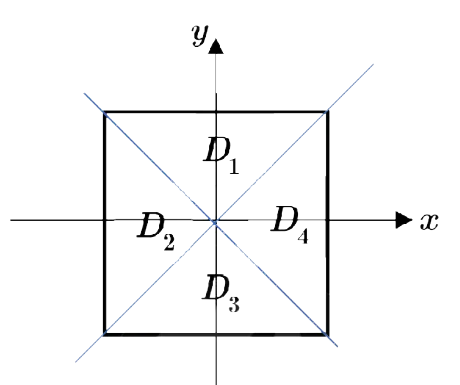
$\text{A.}$ $I_1$
$\text{B.}$ $I_2$
$\text{C.}$ $I_3$
$\text{D.}$ $I_4$